Recently, I was asked by a syndicated columnist to provide statistics on caregiving.
Number of Caregivers in the United States
Estimates vary as to the number of caregivers in the United States. The National Family Caregivers Association commissioned a study a few years back finding 56 million caregivers in the US or about 20% of the population.
I recall reading that about half of today’s caregivers work full or part time. To help in-home caregivers, there are about 800,000 home health aides according to Home Instead. If 20% of the US population provides care for someone, what do the worldwide figures look like?
Number of Caregivers Worldwide
Given the diversity of cultures, statistical figures are often extrapolated to account for lower reports of disease and illness (due to embarrassment--e.g., admitting a family member has Alzheimer’s) while balancing these figures with a higher percentage of families caring for loved ones at home in third world countries due to lack of care-resources such as assisted living or nursing homes. For example, 15 million orphaned children of AIDS in Africa are cared for by grandparents.
Worldwide, the extrapolated estimates approach 1.2 billion caregivers; again, about 20% of the world’s population.
Shortage of Caregivers …
As the Baby Boom generation ages, we’ll come head to head with a shortage of caregivers.
In China
Consider China’s population of single-child households who will begin turning eighty at the middle of this century. China has fewer nursing homes than most developed countries. Who will care for the aging Chinese as their children move to the cities for better opportunities?
In the United States
Consider the numbers of increasing numbers of people being diagnosed with Alzheimer’s disease. According to the Alzheimer's Association 2009 Alzheimer's Disease Facts and Figures report, one new person is diagnosed with Alzheimer’s every 70 seconds. Last year, it was every 71 seconds and the year before that, every 72 seconds. Given the trend, unless there’s a cure, next year, one new person will be diagnosed with Alzheimer’s every 69 seconds. By 2050 when the youngest Baby Boomers reach age 86, there will be a new diagnosis every 29 seconds or two a minute! That's an astounding 1.05 million diagnosed each year in the United States alone!
Escalating Costs of Care
Imagine the escalating costs during the next decade, when 9.9 million unpaid caregivers today are saddled with $148 billion in costs each year as they provide care for 5.3 million people with Alzheimer’s, the 6th leading cause of death.
Can Caregivers Survive Budget Cuts?
Be sure to visit the July News edition: Reducing Support for In-Home Caregivers will Dramatically Increase Government Spending
Brenda Avadian, MA Caregiving/Dementia Spokesperson & Author of 8 booksTheCaregiversVoice.com
For more info also see: Worldwide Home Care Statistics
Here at TheCaregiversVoice.com, we often write about caring for humans. As I've so often said: Once a caregiver, always a caregiver. At least, that's the way it has worked out for me.
This week's posting will be about Narenge, an orange tabby that adopted my husband, David, and me six years ago.
One year after making weekly visits to have his wounds treated with peroxide, I asked David: Why don't we get him fixed?
Crossing his legs (in empathy), David exclaimed, "We don't want to get him fixed; he's not our cat!"
Eventually, David relented. We think a family moved and left their cat behind. Narenge made his way into our lives with our two other aging cats (who went to Rainbow Heaven at ages 19 and 20.)
Scheduled for surgery, Narenge's blood tests showed he carried the Feline AIDS virus. Later, we learned he also had Feline Leukemia. Five years later, we came upon another discovery. Brushing his teeth one afternoon, I noticed his lower right canine (is it called a canine if the tooth belongs to a cat?) had an abscess at the gum line. David took him to the veterinarian only to learn that our kitty has a rare disorder where the body attacks a tooth.
Yesterday, David took him in for dental surgery to have his lower right canine was extracted. And the vet explained that it's very difficult to extract a lower tooth from a cat without fracturing the jaw. So now our baby has a wire holding his lower jaw together for 3 to 4 weeks.
Right now, he's miserable. He's on pain meds and antibiotics. He doesn't want to be handled, but he does remain at the top of the stairs to make sure he's aware of what's going on...a good sign, considering our typically very social kitty could be hiding under the bed!
Sigh...I sometimes wonder: How different are our animal companions' conditions are from our loved ones with dementing diseases like Alzheimer's. My father had difficulty communicating his pain and suffering. So does Narenge.
It is up to us, the caregiver, to sense the minute changes in our loved ones' conditions and to advocate for their proper care. In our case, the veterinarian moved around the surgery schedule to accommodate our kitty's urgent need.
If you're a caregiver in the state of California who provides care for your loved one at home, take five minutes right now. Finish reading this, then pick up the phone and call your legislator and let him/her know that if Caregiver Resource Centers are cut out of the budget, then families will go without the support and strength they need to continue caring for their loved ones at home.
This is DEFINITELY NOT ONE AREA to CUT as the COSTS to California Taxpayers will grow ASTRONOMICALLY if the 80% of caregivers who care for loved ones at home lack the support they need and PLACE LOVED ONES in STATE-SUBSIDIZED HOUSING.
FOUR MILLION taxpaying family caregivers in California have a VOICE. Call and share your story with our elected officials, so they don’t act rashly. Saving a few taxpayer dollars now, while watching the state hemorrhage hundreds of millions in state-aid to families who can no longer care for their loved ones at home is shortsighted.
Pick up the phone and tell your story to the representatives below. Help each understand the absolute impact their decision will have on families across California.
California is an innovative leader among the fifty United States. Let’s help our elected officials make the right decision, preserve our share of federal-matching dollars when we show we care for those who raised us, loved us, and now need us!
Call the Budget Committee Chairs and Sub-Committee chairs and Senate by the end of TODAY!
Senate and Assembly telephone numbers are below. Refer to Budget Item 4440-111-0001.Senators Denise Ducheny Phone: 916-651-2040
Robert Dutton Phone: 916-651-4031 Mark Leno Phone: 916-651-4003 Alan Lowenthal Phone: 916-651-4027 Mimi Walters Phone: 916-651-4033
Assembly MembersKaren Bass Phone: 916-319-2047 Bob Blumfield Phone: 916-319-2040 Noreen Evans Phone: 916-319-2007 Kevin de Leon Phone: 916-319-2045 Roger Niello Phone: 916-319-2005 Jim Nielson Phone: 916-319-2002 You can also find your legislator on the web at www.legislature.ca.gov.
THE MOUNTAIN CLIMB
This past weekend, my husband, his co-worker, and I climbed a mountain in the Angeles National Forest to view a plane-crash site. Starting at 4,900 feet, we climbed to 7,900 feet; first, through pine-needles, then scree (slippery rock and dirt along the side of a mountain). We used trekking poles to keep from sliding down the mountain. Once we reached jagged rocks, we used leather gloves to protect our hands from mutilation.
ALMOST A PILGRIMAGE
Few people take this journey; almost a pilgrimage. Because of this, there are no trails, only deer trails—our footprints following hoof prints. It took us ten hours including two-and-a-half-hours of breaks with a one-hour rest period at the top; where we took time to eat, drink, clean our feet, air out socks, and change toe pads or band aids before memorializing those airborne who had lost their lives decades earlier to this mountain obstacle.
During the nearly three-hour journey back and while my knees ached unbearably (I need a lot more training before tackling Mt. Whitney this September), I got to thinking about caregivers.
CAREGIVERS are like MOUNTAIN CLIMBERS...
Like aspiring wilderness trekkers, caregivers rarely know the full extent of the road ahead. Many of us commit and then take our journey one step at a time. As the journey grows challenging, we often encounter obstacles we believe we can’t surmount. Like mountain trekkers, we need to take a momentary break to catch our breath in order to muster the strength to push forward. Sometimes, we need a little help to maintain our footing on the crumbly terrain. The right tools—whether they are trekking poles, leather gloves, band aids, support group members, family, friends, or other community resources—will prevent us from sliding down the slippery slope of a mountain of caregiving responsibilities.
...ON WELL-WORN TRAILS
Fortunately, caregivers today need not be pioneers on a caregiving journey. Millions have already walked the road of caregiving and hundreds are willing to share their stories. More resources are available to help caregivers—including educational, respite, and in-home care. Instead of having to cautiously navigate along deer trails like caregivers of yesteryear, today’s caregivers are able to follow well-worn and tested paths.
TAKING A PERSONAL JOURNEY
Yet, the journey is still a very personal one, as no amount of resources can lift the entire emotional, mental, and physical toll on each caregiver. For this reason, today’s caregivers must be prepared with the right educational and assistive tools and be willing to take breaks along the way.
When my thigh began cramping severely at the top of the mountain, I had to take a break to rest and re-evaluate how to use my legs differently or risk a rescue. Nothing is more humiliating (not to mention expensive) than to call for a helicopter rescue. The same holds true for caregiving.
AND NEED REST ALONG THE WAY
Caregivers need rest. You need to know when to stop and reevaluate how you’re going to continue your journey. Too many caregivers have needlessly passed on before their loved ones because they exhausted themselves to death. Certainly, no one else can provide as good of care for your loved one as you can. But if you’re not here long enough to provide care, what good has your sacrifice been? Know when to stop, step back, reassess, then call for help before it’s too late.
Now’s the time to enjoy a break—a vacation, a retreat, a weekend at the beach, or a trip to the mountains.
This weekend, I’ll be at the College of the Siskiyous, at the foot of Mt. Shasta (northern California) helping the Mountain Caregiver Resource Center (MCRC) with their annual Caregiver Retreat. The caregiving heroes who will be attending will be taking a much-deserved weekend respite from their daily caregiving duties to regroup, reassess, recreate, and refresh in order to muster the strength and maybe even return with a different mindset about their roles as caregivers. It will be my pleasure to serve these caregivers as I know how much they need this time away from their day-to-day duties of caregiving. For information about the MCRC's programs call: 800-995-0878
This past weekend, I was invited to share my caregiving journey with caregivers at Ask an Expert, an event presented by the Family Care Partnership at the Santa Clarita Adult Day Health Care Center. Representatives of eight agencies were also invited to speak about how their services relate to caregivers’ needs.
Two points arose from this session:
If you are a family caregiver and learn of these community-sponsored events, be sure to attend. Even if you need to make arrangements with a family member, neighbor, or friend to look after your loved one (sometimes these agencies offer onsite complementary care for your loved one), attending will save you days of frustration and effort, chasing the right agency to help you with your needs. Oftentimes, you may not even know to ask for something and may learn the one thing that can really help ease your burden.
If you are a professional and want to serve your community of caregivers, I strongly recommend inviting representatives from neighboring agencies. This will serve two purposes: one, strengthen your community of caregivers’ knowledge and comfort with using resources; and two, give you the opportunity to promote your own services.
For more information and resources please visit our Tips and Information page.
Saturday, May 16 Santa Clarita, California 10am- 12pm
One of the challenges of caregiving is we’re always questioning whether we’re doing the right thing. We could be providing care 24-hours a day and still many of us will doubt if we’re doing enough. If you’ve been watching The Alzheimer’s Project and have questions or need to connect with caregiving experts in the Santa Clarita community…
I invite you to attend Ask an Expert, a special two-hour program (with refreshments and prizes) where experts representing diverse industries will be gathered together to answer your questions. I have been invited to give a special presentation and look forward to seeing you! (If you can’t attend, be sure to forward this to a caregiver in your life.)
Experts representing the following agencies will be on hand to give advice and answer your questions on anything from Alzheimer’s care to access to local services:
• Center for Health Care Rights
• LA Caregiver Resource Center
• Grandparents as Parents
• Personal Assistance Services Council
• In Home Supportive Services
• Alzheimer’s Association
• North Los Angeles County Regional Center
• Santa Clarita Adult Day Health Care Center
• TheCaregiversVoice.com (that’s us!)
Location: Santa Clarita Adult Day Health Care Center
22903 Soledad Canyon Road, Santa Clarita, CA
RSVP: Jillian 818.837.3775 ext.146 or jtarrab@picf.org ***Seating Limited***
Family Care Partnership is made possible by a grant from The SCAN Foundation.
Two writers for a national publication asked: If you could bring back a loved one who has passed on, who would it be and what would you ask him/her?
It would have to be my mother. She died on April 1, 1993 at age seventy-two. I was just thirty-three. Although, my arrival into this world was a disappointment—she really had her heart set on another boy--I did arrive with all my fingers and toes! I was not her favorite as I was more boisterous and less obedient than my sister and brother.
As I move closer to the half-century mark, I find myself thinking more and more about her each day.
A survivor of the 1915-1923 attempted Armenian genocide, she moved from her birthplace of Aintab (a former heavily Armenian-occupied town in Turkey); to Aleppo, Syria; and then to Beirut, Lebanon, prior to immigrating to the United States in 1949. She arrived with an eighth-grade education, a lot of spunk and vigor, a sense of humor, and big dreams.
Marrying shortly before her visa expired, she settled in America, raised three children with the values of hard work and a desire to achieve. She didn’t talk much about the struggles in the “old country.” In fact, she mostly shared stories of joy. Yet, I believe, with all her energy and kindness she would have hoped for a different life. Sadly, she died after suffering from heart failure for thirteen years. The medications kept her alive, but took away her hope for the future until her passing.
If I could ask her a few questions, they would be:
What challenges do you recall from your childhood? What do you think about them, today?
If you could live your life over again, what things would you change?
I’d also ask her more personal questions about being a woman during a time when women did not talk openly about their sufferings—like how she endured hot flashes!
As we approach Mother’s Day, this Sunday, please take time to ask your mother any questions on your mind. There may come a day when, like me, you can only wonder.
After my mother died in 1993, my father invited me to take whatever I wanted from the house, “Look Brenda, what am I going to do with all this stuff? Take what you want.”
My mother always said, “If someone wants to give you something, say, ‘Yes!’ Later, you can decide, ‘No.’”
I looked around, overwhelmed by the results of my mother’s inability to decide “No,” after saying, “Yes” so many times.
My father and I reminisced in the attic of their Wisconsin home of forty-three years. We opened the leather travel trunk my mother carried when she immigrated to America in 1949. Neatly folded among her things was a well-preserved blue cashmere sweater with mother-of-pearl buttons.
My father urged, “Take it. It’ll look good on you, Brenda.”
I declined. “You know what I’d really like? Come, come with me.”
Curious, he followed me down the attic stairs, down to the first floor, and into the kitchen, where I opened the silverware drawer, reached along the left side where the serving utensils were and found The Wooden Spoon. My mother stirred whatever ingredients she had on hand, into fragrant and tasty soups and stews. As a child, I’d beg her for samples.
“That?” my father asked? “Why do you want that?” “Here, take this one,” he insisted, retrieving a newer spoon.
“No, I want this one! This is the one she’d threaten me with when I’d get into trouble!”
Like my mother, until recently, I’ve been holding onto my things.
The last few years; however, I’ve stepped up the pace of going through my things. I have this need to reflect upon and learn from my past. Only months away from reaching fifty, I grow anxious as to the potential relationships I am missing while I spend time on things—mostly magazines, books, training videos in VHS format, audio cassettes, and course files.
I can’t simply toss my history. It is a powerful reflection of where I’ve been, in order to more solidly move forward. It takes time, the process is sometimes stressful, but I believe it is integral to feeling more grounded in life.
Yet, having these things in boxes is a constant reminder that I need to get rid of many of them. A toxic feeling overcomes me each time I have to reach over these boxes to open the blinds in my office or be careful not to stub my toe on the books leaning up against these boxes. (I'm reading and writing reviews of these books before I give them away.)
I've learned an important lesson: be conscientious of what things I bring into my life. I’ve gotten to the point in life where I rarely want things, even if they’re free. When you think about it, free things really aren’t free. They take our time and time is not free; especially when we have so little of it. The way I figure, if I accept something, I have to take time to find a place for it, dust it, take care of it, treasure it, and maybe even worry about someone else taking it. That’s a mighty price to pay! So, if you ever want to give me something, please understand when I consider very carefully whether or not I feel it is worth the price of owning it.
Instead of things, I'd rather spend time building memories with you.
There is something refreshing about writing a new book. There is the desire to express a message in such a way that people’s lives will be significantly impacted. This is the hope of all authors. I am happy to say, this will be my ninth book and a bit of a diversion from my recent titles that dealt directly with caregiving.
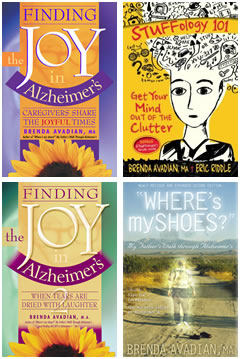
Tentatively titled: The Wooden Spoon: LIFE Abundance in Letting Go, this book has been in the works for the better part of forty-one years! The inspirational force for this new book is an excerpt from the second edition of “Where’s my shoes?” My Father’s Walk though Alzheimer’s (we're celebrating the first edition's tenth anniversary!).
In April 1997 David and I stood in the living room, intimidated
by the prospect of cleaning out my parents’ home. They saved everything!
We faced boxes stacked to eye level. In some places, boxes were
so high, we couldn’t see above them. While moving a stack of boxes,
David was surprised to discover the fireplace that had been hidden
for years!
Upstairs, the once wide-open, bright, and airy master bedroom was
cluttered with cartons, stacked from floor to ceiling against every
wall, except where my mother’s hospital bed stood. The dressing
room with two mirrored closets had not been used in a long time; the
towering boxes barely left enough space to maneuver around. As we
cleared out the dressing room, David exclaimed, “Brenda, I didn’t
know there was another window in here!”
…
David and I went into the basement. There seemed to be fewer
items, but we soon realized this was an illusion. The three largest
rooms of the four allowed everything to be spread out. The smallest
room was stacked floor to ceiling with boxes and wooden crates filled
with motors, spare parts, wire, plumbing supplies, and more. Mardig
(Martin in Armenian and how we addressed my father) accumulated two or
three of the same thing; particularly tools. When he couldn’t find something
or forgot he had a tool, he’d buy another one.
I found three treasures that took me back to my childhood. One
was an old food scale that could weigh items up to twenty-five
pounds. Even though it was not accurate, it was a part of our family
history. Mardig said he used this scale to weigh each of us after we
were born. When we were older, we used it to weigh the watermelons
my mother stored in the cool basement during the summer months.
We had contests to see who could guess the watermelon’s weight.
From “Where’s my shoes?” My Father’s Walk though Alzheimer’s, pages 180-182.
At age eight, I began accumulating things. Forty-one years later, I still have a few of those treasures (a puppy and kitten picture torn out of a magazine that I then painted, stickers, a fat pencil we used in elementary school). Over the years, I continued accumulating. My weakness is mostly books, files, paperwork, audios and videos of personal and professional development seminars.
I want to learn from my parents. When I reflect on their lives and how free they felt to travel and do the things their hearts desired, I realized they were burdened by their things. For example, they had wanted to move to the West Coast for many years. They began packing. But it was all too much. Consequently, they drove across the country several times, but never took their ultimate step of moving. I perceived them as being imprisoned by all their possessions.
I want to learn from them and get rid of as many of my things as I can in order that I may enjoy more of what Life has to offer. There is much to be gained from spending time with people instead of things. Inspired further by many of you who also struggle with letting go; especially, after your children turn down your offer of receiving your things, I began Letting Go.
Return next week, to learn about what I’ve been doing, the benefits, and why I’ve titled this book, The Wooden Spoon.
Janet Spurr’s debut book should come with a WARNING: Possible Injury due to Hearty Laughter!
Looking ahead to warmer temperatures, it's best to be prepared. If you're headed off for a respite near a body of water (for a day or more), take a copy of this FUN book with you! If not, simply pick up a copy and read a story or two each day for a brief in-home respite.
I don't know about you, but when I usually read a funny book, I'll either chuckle or laugh lightly at the funny parts.
Spurr’s story, “Swimming at Wedding Receptions” had me laughing so loud and so hard, I was afraid I cracked my ribs! This story alone is worth the book. But read her other stories first; so you can appreciate her humor and adventure on the beaches of America.
And in this day, when we’re focused on eating right, “Naked Ice Cream” unabashedly flaunts a palatable joy of life in a Jacuzzi or a beach chair. ENJOY! I did!
You'll return to caregiving with a smile.
Beach Chair Diaries: Summer Tales from Maine to Maui by Janet E. Spurr, 2008, Falmouth Heights Books
We used to give a two-by-four to the caregiver who had the worst week caring for his/her loved one in my support group.
It started when I confessed that after a particularly challenging moment of caregiving, my husband and I stood behind my father’s back and pretended to strangle him. This completely uncharacteristic act (for us) made us laugh. The laughter helped us alleviate stress while Finding the JOY in caregiving.
Someone replied, “What I need is a two-by-four.” A few weeks later a nicely painted piece of two-by-four wood with the numbers “2 x 4” clearly painted on it showed up in our support group.
We laughed so hard. Each week, we rotated the two-by-four. The caregiver who needed it the most (who had the most difficult time providing care) got to take it home. Each caregiver kept it for a week and then talked about what happened that week before returning it to the support group. One caregiver carried it in her car behind the passenger seat. Her husband was acting up while she was driving him to the doctor. As she faced him, she caught a glance of the two-by-four and began laughing. Several weeks passed and each caregiver took a turn at the two-by-four. One higher functioning care recipient even asked: What’s that two-by-four for? His caregiver began laughing. Weeks passed when a caregiver told us that she kept it in the kitchen. One day, when her mother really tested her patience, she mustered all the strength she had to resist using it. After this, the two-by-four stopped making the rounds. We feared someone might actually use it!
Now, the two-by-four stands as a reminder in the support group and the story is told to new caregivers.
The truth is, while caregiving is rewarding, it can be very trying and to preserve our health and sanity we need to vent, to let off steam. As many of you gather with your families and friends for Passover and Easter during the following days or go about your other activities, I invite you to share the following two links or copies of these articles with your family and friends. These two articles about elder abuse are not funny. In fact, being aware of them can save you and your loved ones a lot of heartache. Start with Elder Abuse Hits Home and then AKUDA: The Martial Art of Abuse Prevention.
In January, I announced our celebration of the 10th anniversary of the first edition of “Where's my shoes?" My Father's Walk through Alzheimer's.
Sixteen years ago, yesterday, I had an unusual conversation with my father. Dementia may have been showing early signs in him at this time; though we wouldn’t recognize it until three years later.
“Brenda, how are you? I hope I’m not interrupting anything. I’m calling to let you know Ma died.”
WHAT? Is this real? I quickly weigh a couple thoughts. First, my father never calls me—too expensive to talk long distance—so I phone him every month. Second, is he kidding me? This is April Fools’ Day—a day when people play practical jokes on each other. I decide not to be a victim of his joke.
“You’ve got to be kidding!” I exclaim.
“No,” comes his somber reply.
“C’mon, it’s April Fools’ Day. Whad’ ya tryin’ to pull?”
“I couldn’t believe it myself when the nurse called only one hour after I left her,” he says with an awkward chuckle.
“In fact, I thought the nurse was kidding me and I told her so! But she assured me that when she came back into Ma’s room Ma had passed away.”
“Wow.” Do I feel like a fool! “Mardig, how are you doing?” (We called my father by his first name, Martin. In Armenian, it is pronounced MAR-deeg, with the emphasis on the first syllable.)
“Well, under the circumstances, I’m doing all right. I’m just a bit surprised.”
My father, the diplomat, the gentleman, and master of controlling his emotions. “Well, I’ll fly back to visit you then. What do you need?”
“Oh, no. Don’t come. You’re working. Don’t take time off from work.”
My father worked at General Electric for thirty-two years without a single day of absence. He received special recognition for this rare achievement.
“Mardig, I will come. This is not a decision for you to make. I will help you with Ma. Besides, our family must be together during this time.”
“No, that’s not necessary. I have taken care of everything.”
“Oh yeah? What have you done?”
We go back and forth, playfully quarreling, until he finally agrees to let me return to help him and to spend time with him.
How time flies. Sixteen years ago, today. And what a coincidence; a massive stroke caused by Alzheimer’s took my father eight years and a day before that phone call, on March 31, 2001. And here’s the other amazing detail. During my childhood, my father always said that my mother would live eight years longer than he, recalling actuarial data at the time. And despite his being ten years older than my mother, she died eight years before he!
Having lost each, first, when I was 33 and then at 41, as I move months from the eve of my life’s half-century mark, I feel their lives paralleling mine. I wish they were here so I could ask them questions or laugh with them about growing older. One morning while jumping on the bed and trying to get my father to get up and start our weekend adventures, he asked what time it was. I was amazed: You mean you can’t see that clock. C’mon, I can see it really easily! He warned me: Now listen Little Girl, someday, you too will not be able to see as well, and your children will tease you. Well, I escaped teasing from children (all we had were cats); but the memory still brings a smile to my face.
Excerpted from “Where's my shoes?" My Father's Walk through Alzheimer's, (2nd ed.) by Brenda Avadian, MA (Chapter 1: The Telephone Call).
This past Saturday, Mr. Eldercare interviewed me about the topic: The Guiltless Senior Housing Decision. Noted Author and Caregiver offers provocative insight.
Family caregivers about to place or have placed their loved one and are suffering from guilt or regret will benefit from listening to the archive of this 30-minute call.
Topics covered include: 1. Emotional hurdles to overcome in deciding to place or having just placed your loved one. 2. Process of deciding which is the right decision. 3. Financial impact of seeking professional care. 4. How family members help or hinder your decision and how to deal with this. 5. Challenges of providing care. 6. Making plans. 7. What happens when disaster strikes?
Professionals called in and even contacted me following the interview to offered additional perspectives. (I will follow up with them and see if we can feature a few of their services in upcoming blogs.)
Because this decision impacts YOU, we'd love to hear from family caregivers.
Those who want more details and the entire span of the caregiving experience, please be sure to read "Where’s my shoes?" My Father’s Walk through Alzheimer’s.
This Saturday, Mr. Eldercare will be interviewing me about the topic: The Guiltless Senior Housing Decision. Noted Author and Caregiver offers provocative insight.
Tune in, call in! Family caregivers faced with those guilt-ridden decisions when they can’t care for their loved one at home any longer are especially invited to call.
We will discuss how to choose the most appropriate care option for your loved one. As readers of TheCaregiversVoice.com, you already know, we present an independent voice--since 2002 (website) / 1996 (me)--on caregiving issues. If you are a professional representing a nursing home, assisted living, or board and care, we want to hear your thoughts. If you are a family member about to place, have recently placed and are suffering regrets, or have placed your loved one a while ago, we also want to hear from you.
A LIVELY 30-minute discussion WITH YOU…this Saturday! And the best call-in question, determined by Mr. Eldercare, will receive an autographed copy of "Where’s my shoes?" My Father’s Walk through Alzheimer’s.
Please be sure to put a reminder in your calendar Saturday morning, March 21, 2009 at 11a ET, 10 am CT, 8a PT) Click on The Guiltless Senior Housing Decision. Noted Author and Caregiver offers provocative insight for the live show…then we invite you to call in (646) 595-3880 with comments and questions. The show will be archived at Ask Mr. Eldercare.
We look forward to hearing from you!
Memory Lessons: A Doctor’s Story by Jerald Winakur, MD is a rare and valuable first-person account by an MD who is also a caregiver walking the road of Alzheimer's with his father.
A joy to read, Dr. Winakur’s writing reads as like a literary work--poetic in places and philosophical in others. He sheds light on the hidden details of what it means to be a medical doctor across a thirty-year period (a bonus for readers) while trying to be a good son and caregiver to his head-strong father.
Is it any easier to be a caregiver, because he is a doctor? No. In fact, it seemed harder at times. He visited his father regularly, sometimes daily; even though he was not his father’s doctor.
The book is like a tapestry woven from the vivid threads of his life—from the not-so-easy relationship with his father to their shared love of birds and fishing; from his early years in medical school through residency to his own medical practice. He opines on the real costs of medicine shared by patients, doctors, and insurers; partly due to governmental regulations and partly, to emotional costs. If you have an opinion about your current medical care, read this book. You’ll gain some unexpected insights.
I was touched by the number of similarities between his recollections and my own. One example is Dr. Winakur, his brother, and their mother hid his father’s shoes. We used to hide my father’s shoes; hence his (grammatically incorrect) question, “Where’s my shoes?” Another example is his father’s oft-repeated advice: Let that be a lesson to you. Similarly, my father advised: Keep your head about you. These lessons of our fathers will stay with us during our own life journeys.
Two highlights of this book were particularly memorable. The foremost is his touching and philosophical views on falling as we age. He writes of how we fold back down to the earth. Winakur even offers perspective on falls at home and in skilled nursing care settings. Coming from an MD, his words are credible and enlightening. The second, and important for all of us, is to have an engaging and candid discussion of the meaning of life and death with our loved ones--one discussion Dr. Winakur regrets not pursuing with his father.
A great eye-opener for caregiving families. General practice physicians are urged to read this book to gain a better appreciation for and understanding of caring for older people; especially, Chapter Six. Social workers and nurses working with older people; particularly, those showing signs of dementia, will receive much benefit from reading this book.
A caregiver sent me an eMail with a link to a study. Published at Sci-TechToday.com, this study revises results from previous studies of familial cases of Alzheimer's.
Whereas, earlier research studies reported that children of parents with Alzheimer’s had a 10% chance of getting the disease, Alzheimer's Study Finds Parental Link initially paints an ominous picture of memory loss.
The good news? This is only an initial study; one that invites awareness and asks other scientists to replicate the results. Until then, we don’t have much to be alarmed about.
Alzheimer's struck BOTH sides of my family--my father and my aunt (my mother's sister). I often wonder, had not heart disease taken my mother first, would she have suffered from a form of dementia (e.g., vascular)?
For the interim, as we wait for replicated results, I’d like to add another variable to this study: Test anxiety.
For as long as I can remember, I have suffered from test anxiety. Consequently, I've had to take heroic measures just to pass a test. In my early-forties, I self-administered the Mini Mental Exam, a thirty-point test given initially to diagnose possible cognitive loss. I scored a 27. If I were thirty to forty years older, a proactive and concerned doctor (maybe one who consults for the pharmaceutical industry) might prescribe cholinesterase inhibitors such as donepezil (Aricept), rivastigmine (Excelon), or galantamine (Razadyne) to delay further decline. But because I was too young to signal alarm bells (and had taken the test to prove a point to older caregivers who were concerned about their own memory loss), my test results elicited laughter and relief. It was likely that these folks enjoying themselves (at my expense) were experiencing bouts of caregiver dementia--memory loss due to the stress and exhaustion associated with caregiving.
Consider how you might feel surrounded by family and medical specialists asking you to spell W-O-R-L-D backwards and trying to recall three words five minutes after your mind has been fixated on why all these people are asking you these questions and what they plan to do with you.
My advice: Keep reading. Be aware. Don’t waste your valuable life in fear. Keep your sense of humor.
Having walked the caregiving road beside my father as he journeyed into Alzheimer’s (see "Where’s my shoes?" My Father’s Walk through Alzheimer’s), I found P. Murali Doraiswamy, MD and Lisa P. Gwyther’s, MSW approach to The Alzheimer's Action Plan to be both comprehensive and compassionate.
Whether you’re the caregiver or the one diagnosed with Alzheimer’s; you will find The Alzheimer’s Action Plan to be a dignified and compassionate guide along the road ahead.
There is so much genuinely helpful information in this book that if I mentioned everything worth noting here, I’d risk writing another book!
Highlights from this nearly 500-page bible for caregivers of people with Alzheimer’s and those who have been diagnosed early in the disease cycle:
Maintaining social connections through volunteerism, family activities, or other in later years in order to delay the onset of Alzheimer’s (assuming health, education, stress variables are equal).
Nine common behaviors and tips to handle them—such as the abstract concept of time (losing sense of time) or accusations of betrayal.
You (the caregiver) deserve care too, plus the one-minute respite (pages 257-260). I’ve long advocated the five-minute respite for caregivers who feel too busy to take a break.
What to expect during and making the most of your doctor’s appointment. Chapter 5 will save you lots of stress and frustration.
Medications for depression, anxiety, sleeplessness, and the worst behavioral symptoms. Chapters 14 & 15 provide life-saving information; particularly, when some prescribed medications (e.g., Haldol) may not be as well tolerated by older care recipients (especially those living with Alzheimer’s) versus another (e.g., Ativan). Take this book with you when you see the doctor and ask the questions noted on page 317.
Heartfelt and workable ideas to meet the challenges of bathing or dressing (p. 244).
Reasons to move your care recipient. Two targeted and very helpful pages (pages 274-276).
If there’s one area that could use more attention it is the one that addresses sexual issues. I recall my father’s behaviors had a profound and lasting effect on me. Although, The 36 Hour Day only devotes a page-and-a-half, while "Where's my shoes?" devotes an entire chapter to sexuality and Alzheimer’s, The Alzheimer's Action Plan devotes about 5 pages or 1% of the entire book to this topic. Still the authors handle sexuality respectfully and with kindness (p. 201-2, 255-7 and 393).
Doraiswamy and Gwyther offer a Top 40 Q &A section divided across six subject areas. The compassion with which each response is offered reflects thoughtful and heartfelt consideration from both the caregivers and care recipient’s perspectives.
Caregivers are urged to start reading this book by scanning the index for the topics they need information on now instead of trying to read the entire book. Like the Bible, this book is best digested in pieces, applied, then reviewed.
A must read for all family caregivers of loved ones with dementia, those diagnosed with early stage dementia, and for all physicians, nurses, and social workers whose clients include those diagnosed with dementia.